Content Adaptation based on difficulty levels
This involves the process of adjusting instructional materials to match each learner’s abilities, prior knowledge, and learning progress. It therefore includes content difficulty adjustments to achieve a personalised learning experience.
Example of its application using adaptive systems:
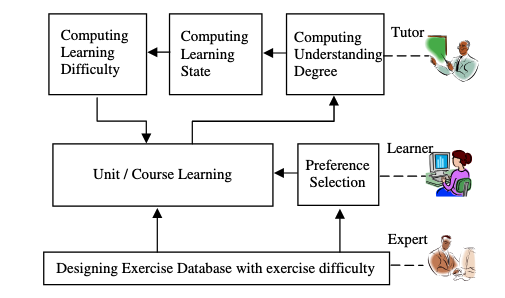
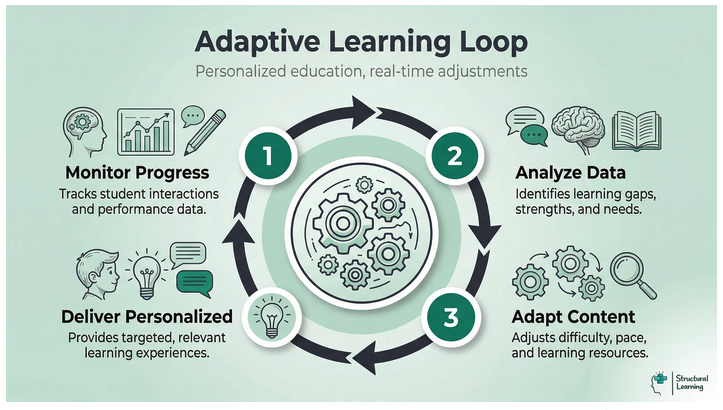
Adaptive systems can support personalised learning by dynamically modifying content to align with individual learners’ abilities and knowledge levels. As learning progresses, the system continuously monitors performance and uses feedback mechanisms to refine and adjust task difficulty. If a student demonstrates strong understanding, more complex materials can be introduced; if challenges are detected, simplified content, additional practice, or targeted support can be provided.
Technology such as machine learning and data analytics can be utilised to create adaptive systems that dynamically modify content through difficulty-level adjustments, reflecting learners’ experiences and performance.
Resources
- How does AI adapt game difficulty for individual learners?
- Adaptive Learning in Education
- Build an AI-Powered Learning Management System That Actually Trains People
References
- Cai, Q., & Liu, Q. (2024, September). Exploration and practice of personalized education based on adaptive learning systems. In Proceedings of the 2024 International Symposium on Artificial Intelligence for Education (pp. 54–58).
- Chen, C.-M., Lee, H.-M., & Chen, Y.-H. (2005). Personalized e-learning system using Item Response Theory. Computers and Education, 44(3), 237–255. https://doi.org/10.1016/j.compedu.2004.01.006
- Chen, C.-M. (2009). Personalized E-learning system with self-regulated learning assisted mechanisms for promoting learning performance. Expert Systems with Applications, 36(5), 8816–8829. https://doi.org/10.1016/j.eswa.2008.11.026
- Du Plooy, E., Casteleijn, D., & Franzsen, D. (2024). Personalized adaptive learning in higher education: A scoping review of key characteristics and impact on academic performance and engagement. Heliyon, 10(21).
- Er-Radi, H., Aammou, S., & Jdidou, A. (2023). Personalized learning through adaptive content modification: Exploring the impact of content difficulty adjustment on learner performance. Conhecimento & Diversidade, 15(39), 263–275.
- Main, P. (2025, March 17). Adaptive learning in education: A guide to personalized teaching. Retrieved from www.structural-learning.com/post/adaptive-learning
- Tseng, J. C. R., Chu, H.-C., Hwang, G.-J., & Tsai, C.-C. (2008). Development of an adaptive learning system with two sources of personalization information. Computers and Education, 51(2), 776–786. https://doi.org/10.1016/j.compedu.2007.08.002
- Zhu, G., Liu, W., & Zhang, S. (2010, December). Designing personalized learning difficulty for online learners. In International Conference on Web-Based Learning (pp. 264–275). Berlin, Heidelberg: Springer Berlin Heidelberg.